Is a solar power system worthwhile for musicians? My experience report.
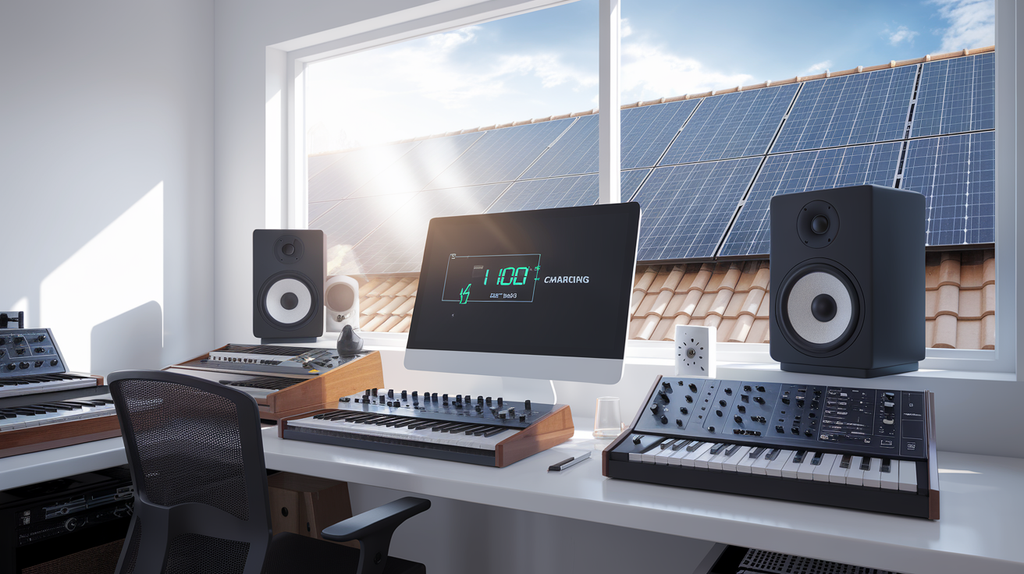
Energy is becoming increasingly expensive – and for musicians running a home studio, electricity consumption can quickly add up. The idea of using your own photovoltaic system (PV system) to cover the electricity needs for music production, rehearsals, or live streaming sounds appealing. But is it really worth it? Here, I share my experiences with my own system and provide an overview of what musicians should consider.
My PV system: From feed-in to storage system
I've been using a balcony solar system for quite some time, but until October 2024 I only had direct feed-in via a microinverter . Even with that, I was able to cover a noticeable portion of my electricity consumption.
Since October 2024, I have upgraded my system and now operate 5 solar panels, each with 420 watts , as well as an Anker Solix 2 Pro battery with 1.6 kWh . I plan to add one or two more batteries to store more energy.
How much electricity can I cover with my system?
Here are my measured values so far for the self-consumption rate of PV electricity:
- October: 13% of my electricity needs
- November: 4%
- December: 2%
- January: 7%
- February: 11%
- March: 24% (so far)
Clearly visible: In winter the PV system produces little, but as soon as the sun gets stronger in spring, the yield increases.
Power limitation: Feed-in limit at 800 watts
An important point to consider for anyone with a balcony solar system: In Germany, a plug-and-play PV system is only allowed to feed a maximum of 800 watts into the house grid.
That means:
- If more electricity is produced than can be consumed or stored, it is lost.
- This applies particularly to sunny days, when the system generates over 1200–1300 watts , but only 800 watts may be fed into the grid .
- If I don't need the 800 watts myself, the surplus automatically flows into the grid – without compensation.
In my case, the battery is fully charged by 2 PM on sunny days . After that, the system limits the power input to 800 watts – the rest is wasted. With a larger battery, I could consume even more myself and avoid losses.
Why is this interesting for musicians?
Musicians who run a home studio often have high continuous power consumption due to computers, monitors, amplifiers, and audio equipment. In my case, the iMac and the 32-inch widescreen monitor are the biggest power consumers. Anyone who also uses electric heaters or air conditioners should factor that in as well.
The problem with usage times
One important point: When do you use your studio the most?
- Mornings (9-13 am) : Perfect for PV systems, as this is when the highest yields are achieved.
- Evenings (6-10 pm) : Problematic, because there is hardly any solar power available then.
I work in the mornings on my days off, which works well. On regular workdays, however, I only use the studio in the evenings – by then my solar panels aren't generating any power. A larger battery storage system can help here, allowing me to use the energy stored during the day in the evenings.
Weather dependency: A factor not to be underestimated.
Of course, electricity production is heavily dependent on the weather . On sunny days, the PV system can deliver good output, but on cloudy days or in winter, the yields are significantly lower. I noticed this particularly in December and January – during these months, my electricity share from PV was only between 2 and 7% .
Another problem in winter:
- The sun is very low in the sky , which means the modules receive less light.
- Additionally, I have a lot of shade from the houses opposite , which further reduces performance.
That means:
- A larger PV system or additional storage can help to compensate for weather-related fluctuations.
- Those with a consistent energy demand should not rely solely on PV, but should carefully plan their remaining electricity needs (e.g., with cheaper night-time electricity tariffs or more flexible working hours during the day).
Is it financially worthwhile?
That depends heavily on your own usage and the orientation of the modules. I calculated the payback period for my entire system, including the mounting brackets, and it's between 4 and 5 years . After that, the system will produce "free" electricity – an attractive prospect!
Are there any problems with the system?
No. I haven't experienced any interference with the audio signal or humming from the PV system so far. Integration into my home network was also trouble-free.
My conclusion: Should every musician install a solar power system?
Everyone needs to calculate this for themselves. Those who work a lot during the day in the studio and have high-energy-consuming equipment can benefit significantly. Self-consumption can be maximized, especially with an additional battery storage system. However, those who only work in the studio in the evenings or who cannot easily integrate weather-dependent electricity into their daily routine should carefully consider whether a PV system is worthwhile.
For me it was a worthwhile investment – and with a larger battery I will increase my energy independence even further.
Feel free to check out the video on my second channel:
https://youtu.be/_oMMM2ejv6s
-
Posted in
Anker, Balkonkraftwerk, Energie, Homestudio, Photovoltaik, Solar, Solix, Strom, Studio