MIDI Basics – What is MIDI and what can you do with it?
What is MIDI?
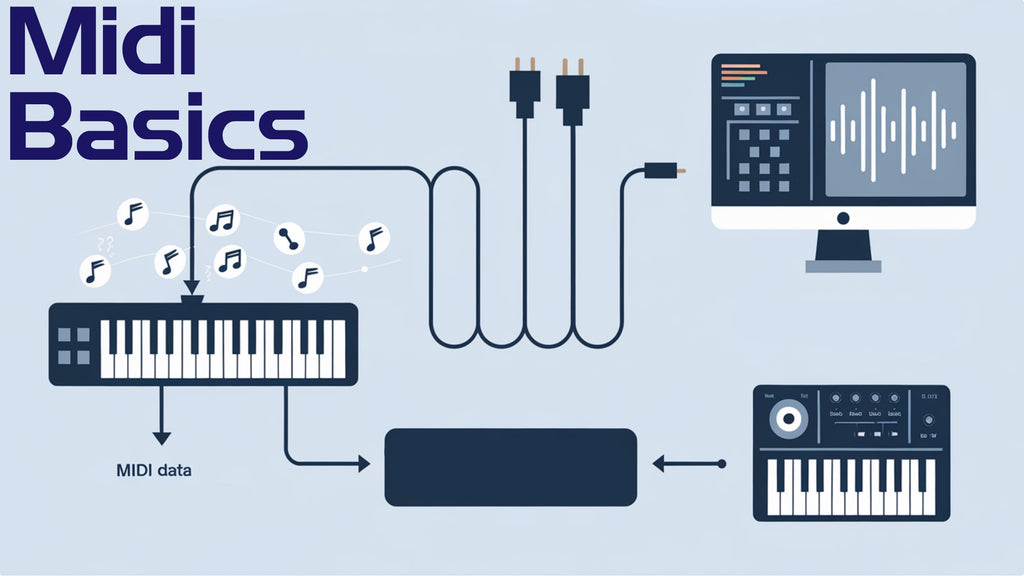
MIDI (Musical Instrument Digital Interface) is a digital protocol for control and communication between electronic musical instruments, computers, and other devices. Unlike audio, which actually transmits sound, MIDI only sends control commands to execute notes, parameters, and other functions.
Difference between MIDI and Audio
A common misconception is that MIDI transmits sound – this is not the case. The difference is easy to explain:
-
Audio: Transmits sound waves, which are usually carried via jack or XLR cables. That's what we hear.
-
MIDI: Sends control commands, such as which note should be played, how loud it is, or whether an effect is switched on or off. Furthermore, MIDI enables remote control of synthesizers, DAWs, or other devices.
Various MIDI connections
MIDI typically comes in the following different versions:
-
Classic 5-pin MIDI cable (DIN connector)
-
MIDI via USB (direct connection to computers and controllers)
-
MIDI over Bluetooth (wireless connection to mobile devices or synthesizers)
Theoretically, other plug types could also be used via adapters.
What signals are sent via MIDI?
1. Note commands
-
Note On/Off: Indicates which key was pressed or released.
-
Velocity: The force with which a note is played (resolution: 0-127, MIDI 2.0 offers higher resolutions – a topic for a later video).
2. Program Change (PC)
-
Allows switching between different sounds or presets of a synthesizer.
-
Supplemented by MSB/LSB values to specifically target certain banks.
3. Control Change (CC)
-
Control of parameters such as volume, filters, or effects.
-
Examples:
-
CC 64: Sustain pedal (0 = Off, 127 = On)
-
CC 7: Main volume
-
CC 1: Modulation wheel
-
CC 11: Expression (Dynamic control of volume or other parameters)
-
4. MIDI channels
MIDI supports 16 channels , allowing different devices or sound generators to be controlled separately. This means a keyboard can simultaneously control multiple synthesizers or plugins.
What can you do with MIDI?
MIDI is extremely versatile and is used in many areas of music production and live performance:
-
Live keyboard setups: Control of software synthesizers or external modules.
-
Effect control: Switching and controlling effects in real time.
-
DAW integration: Using MIDI controllers to control recording software.
-
Lighting control: Connection to DMX systems for live stage lighting.
Conclusion
MIDI is one of the most important tools for modern musicians, enabling flexible control of a wide variety of devices. In upcoming blog posts and videos, I will demonstrate the practical applications of MIDI in more detail – from controlling individual parameters to synchronizing multiple devices.
👉 Watch the first video in the MIDI series here: Watch the video!
Stay tuned for the next post: MIDI in practice – controlling hardware & software !
-
Posted in
Midi, Midi 2.0, Midi Grundlagen, Midi Keyboard, Midi Steuerung, Midi Tutorial, Midi vs Audio, Midi-Controller