The basic structure of a synthesizer – How sounds are generated
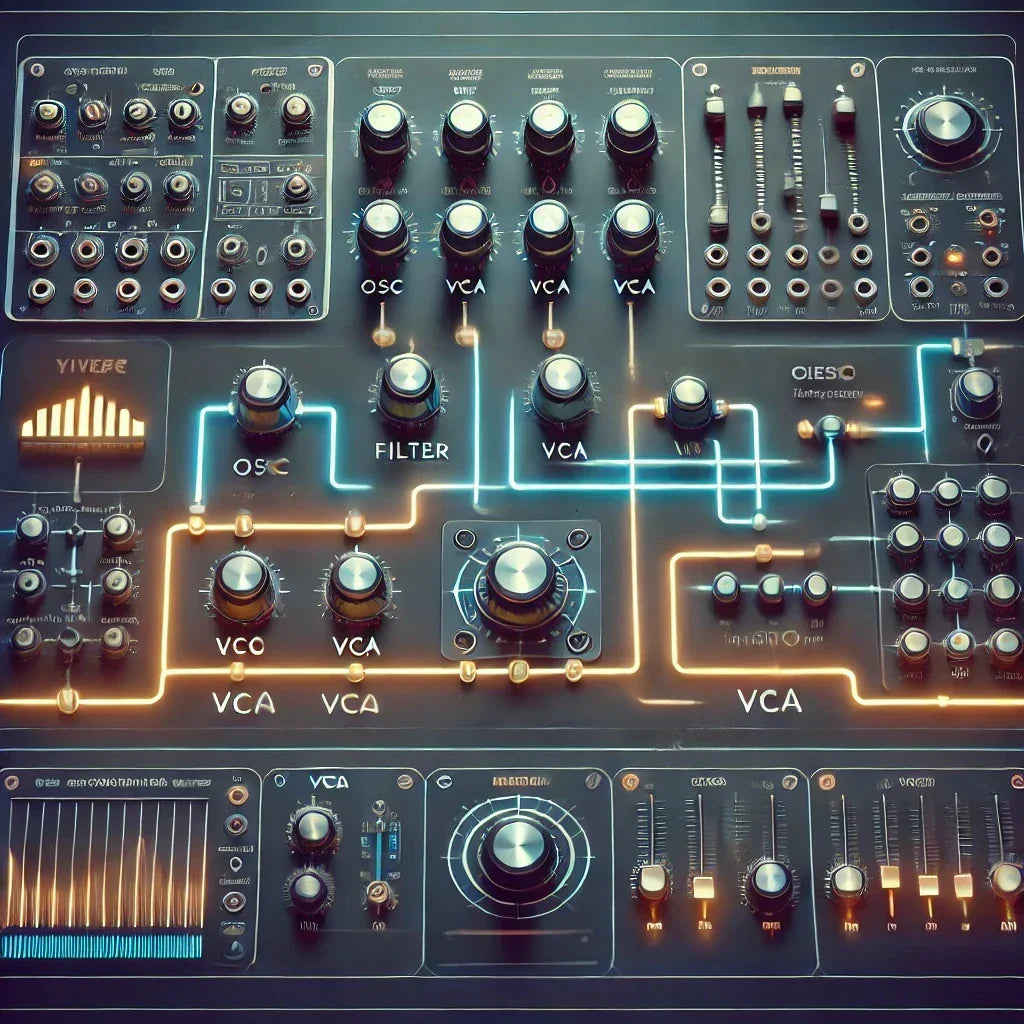
Synthesizers are versatile tools for sound generation and shaping. But how is a sound created in a synthesizer? The structure follows a specific sequence of modules that work together to generate and manipulate sound. Here is a basic explanation of the main components and their functions.
1. Oscillator (OSC – Oscillator)
The oscillator is the heart of a synthesizer, as it generates the raw sound. This is where the fundamental waveforms are created, such as:
- Sine wave (soft sound, hardly any overtones)
- Sawtooth (rich in overtones, good for rumbling basses and sharp leads)
- Square/Pulse (hollow sounding, ideal for leads and basses)
- Triangle wave (softer than sawtooth, but more overtones than sine wave)
Many synthesizers offer multiple oscillators that can be combined to create more complex sounds. Some modern oscillators also allow the use of arbitrary waveforms or the loading of custom samples, enabling even greater sonic diversity.
2. Filter (VCF – Voltage Controlled Filter)
After the sound is generated by the oscillator, it passes through the filter. The filter shapes the sound by amplifying or attenuating certain frequencies. The most important filter types are:
- Low-pass filter : Allows low frequencies to pass through and removes high frequencies.
- Highpass (Hochpass) : Allows high frequencies to pass through and removes low frequencies.
- Bandpass : Only allows a specific frequency range to pass through.
- Notch (bandstop) : Removes a specific frequency range.
The resonance setting allows you to emphasize certain frequency ranges, which can result in a characteristic "whistling" or "singing" sound from the filter. Additionally, there is often a separate envelope for the filter , which allows you to control the frequency response over time, similar to an ADSR envelope for volume.
3. Amplifier / Amplitude Envelope (VCA & ADSR)
The amplifier (VCA – Voltage Controlled Amplifier) determines the signal's volume. Besides the classic ADSR envelope, there are also more complex variants with additional parameters, such as dual attack or decay phases , which allow for even more precise control of the volume curve. Most often, the volume is shaped using an ADSR envelope . Just like the amplifier, the filter also has envelopes that, for example, ensure a sound starts off muffled and then brightens, or vice versa.
4. LFO (Low Frequency Oscillator)
The LFO is a slow oscillator that can modulate other parameters.
Possible applications:
- Vibrato (pitch modulation by the LFO onto the oscillator)
- Tremolo (volume modulation by the LFO onto the amplifier)
- Filter sweeps (LFO applied to the filter)
5. Modulation and Effects
Modulation sources such as envelopes, LFOs , or external controllers can influence various parameters and add movement to the sound. Additional effects like reverb, chorus, or delay can also be added.
Conclusion
The sound in a synthesizer is created in a clear sequence: oscillator → filter → amplifier → modulation . By selectively adjusting these modules, countless sounds can be generated – from gentle pads to aggressive leads. Understanding this structure allows you to create and customize sounds with precision!
-
Posted in
ADSR, filter, Klangerzeugung, LFO, Musikproduktion, Oszillator, Synthesizer